If d [f (a), f (b)], then there is a c [a, b] such that f (c) = d.
Get Intermediate Value Theorem Table Pictures. Once it is understood, it may seem obvious, but mathematicians should not underestimate its power. The intermediate value theorem can fix a wobbly table.
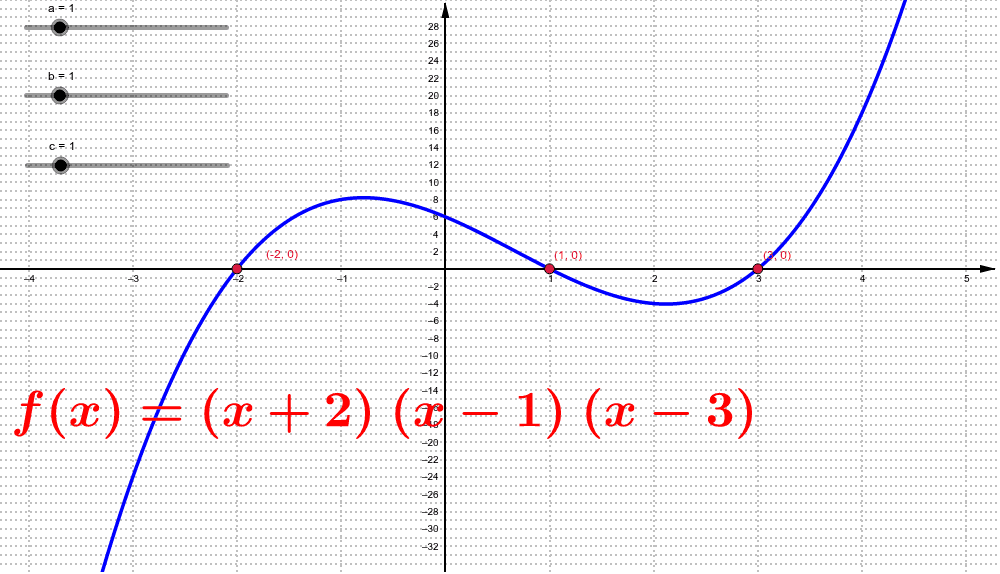
Lab06 Polynomial Function Graphs; Long and Synthetic Division – GeoGebra from www.geogebra.org
Then there exists a number x0 a, b with f(x0)=0. At some point within the interval. If your table is wobbly because of uneven ground.
The intermediate value theorem (often abbreviated as ivt) says that if a continuous function takes on two values y1 and y2 at points a and b, it also takes on every value between y1 and y2 at some point between a and a and b.
The intermediate value theorem offers one way to find roots of a continuous function. At each end of the interval, then it also takes any value between. Let, for two real a and b, a < b, a function f be continuous on a closed interval a, b such that f(a) and f(b) are of opposite signs. A root (or solution) occurs at any x value where f(x) is 0, so when you analyze data on a table, you really only need to look at the f(x) values and see where.